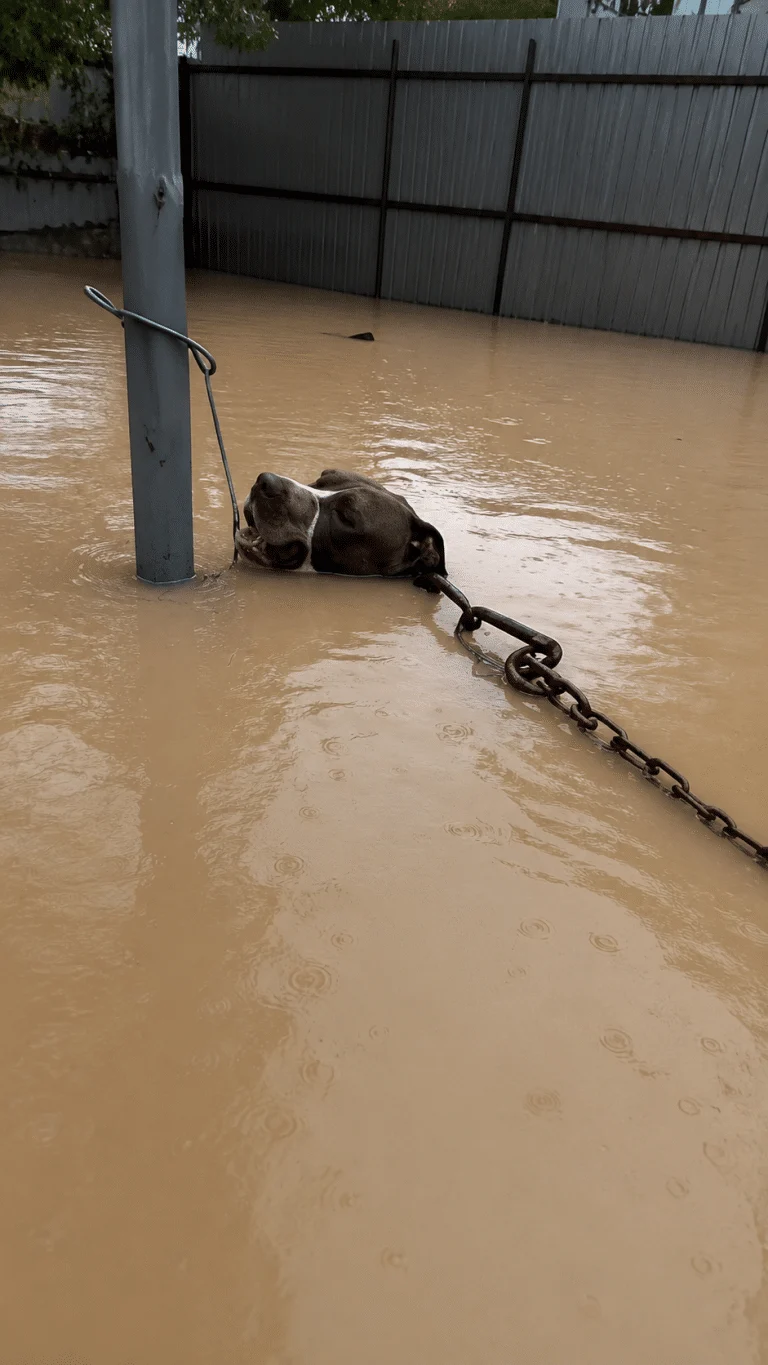
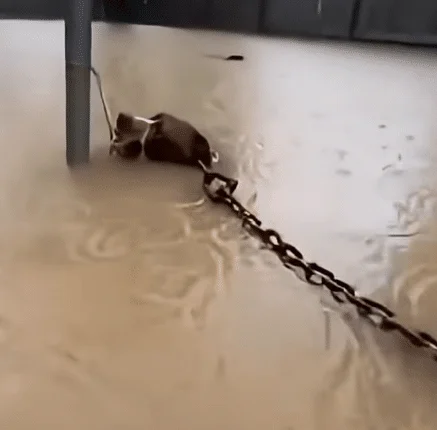
Floodwaters swallowed nearly everything in a once-familiar yard, leaving only a metal pole visible above the murky surface. Beside it stood a brown-and-white Pit Bull, tethered by a heavy, rusted chain that left him almost no room to move. As the water crept higher, it lapped at his chest and eventually reached his throat, forcing the dog to stretch his head upward just to breathe.
The dog’s legs trembled under the strain, and each wave reaching over his body brought exhaustion a little closer. The flood had erased any safe ground nearby, and the chain made escape impossible. Resting was not an option, as lowering his body even slightly meant submerging his nose beneath the water.
When a rescuer finally pushed through the flood to the dog’s side, the moment held both urgency and uncertainty. The dog remained close to the chain’s limit, eyes fixed on the approaching figure, as the floodwaters swirled around them both. Whether the locked metal would surrender and allow the dog’s release was still unknown.
Video: Rescuer Approaches a Dog Stranded by Rising Floodwaters and Rusted Chain
Confronting the Lock That Held Life in Place
Entering the flooded yard was perilous—not just because of the water’s depth, but due to hidden hazards such as unstable soil and debris unseen beneath the surface. Each careful step forward brought the rescuer closer to the dog, whose body remained strained against the immovable chain.
The lock securing the chain was heavily corroded, its mechanisms jammed by rust and dirt. Attempt after attempt to free it met with frustration. Fingers slipped on the soaked metal, and despite steady persistence, the lock refused to relent.
Time passed in slow increments as the dog, muscles taut, continued to stretch his neck above water, struggling simply to breathe. The rescuer’s hands became scratched, a physical testament to the effort required to undo the chain that held the animal captive.
A Quiet Relief Beyond the Struggle
After relentless effort, the lock finally gave. With a sharp release, the chain loosened its grip, and the dog was no longer anchored in place. The rescuer stepped close, supporting the exhausted animal before the current could claim him.
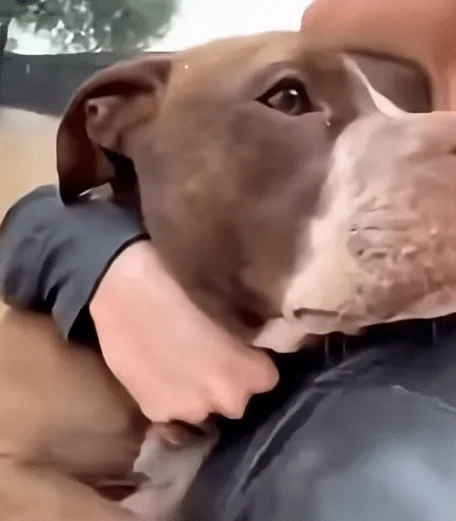
For the first time since the ordeal began, the dog no longer needed to bear his own weight. Instead of paddling and resisting the chain’s pull, he lay quietly against the man’s chest. His breathing slowed, and his head settled against the rescuer’s shoulder as they made their way toward dry land.
The rescue’s most poignant moment was unassuming: a weary dog finally surrendering to the care of another. No thrashing or resistance, just quiet trust displayed in a vulnerable pause.
The Toll and Meaning of Being Tied Down in a Flood
Floods pose inherent threats to any animal caught without shelter. For one tethered to a fixed point, the risk deepens exponentially. While many creatures might search for high ground or evade the strongest currents, this dog’s fate was dictated by the length of a chain and the height of rising floodwaters.
He did not choose to remain by that pole. The chain was an unyielding boundary that trapped him as his surroundings became increasingly hostile. His survival depended entirely on intervention—the courage and determination of someone willing to enter dangerous waters and battle stubborn iron to restore his freedom.
The flood had swallowed a yard, but the greater struggle was to break the bonds that confined the dog.
Moving Toward Safety and Tomorrow
As they moved away from the pole, the rescuer held the soaked, tired dog steadily through the rising flood. The immediate crisis had passed, though care was still needed—warmth, food, rest, and a thorough health check awaited beyond the waters.
The open chain disappeared beneath them, leaving behind the heavy restraint that had demanded every ounce of the dog’s strength. Now, supported by human hands, the dog could finally let his body rest without constant effort.
“Sometimes, the smallest sign of trust is the moment that tells you how far an animal has already come.”