
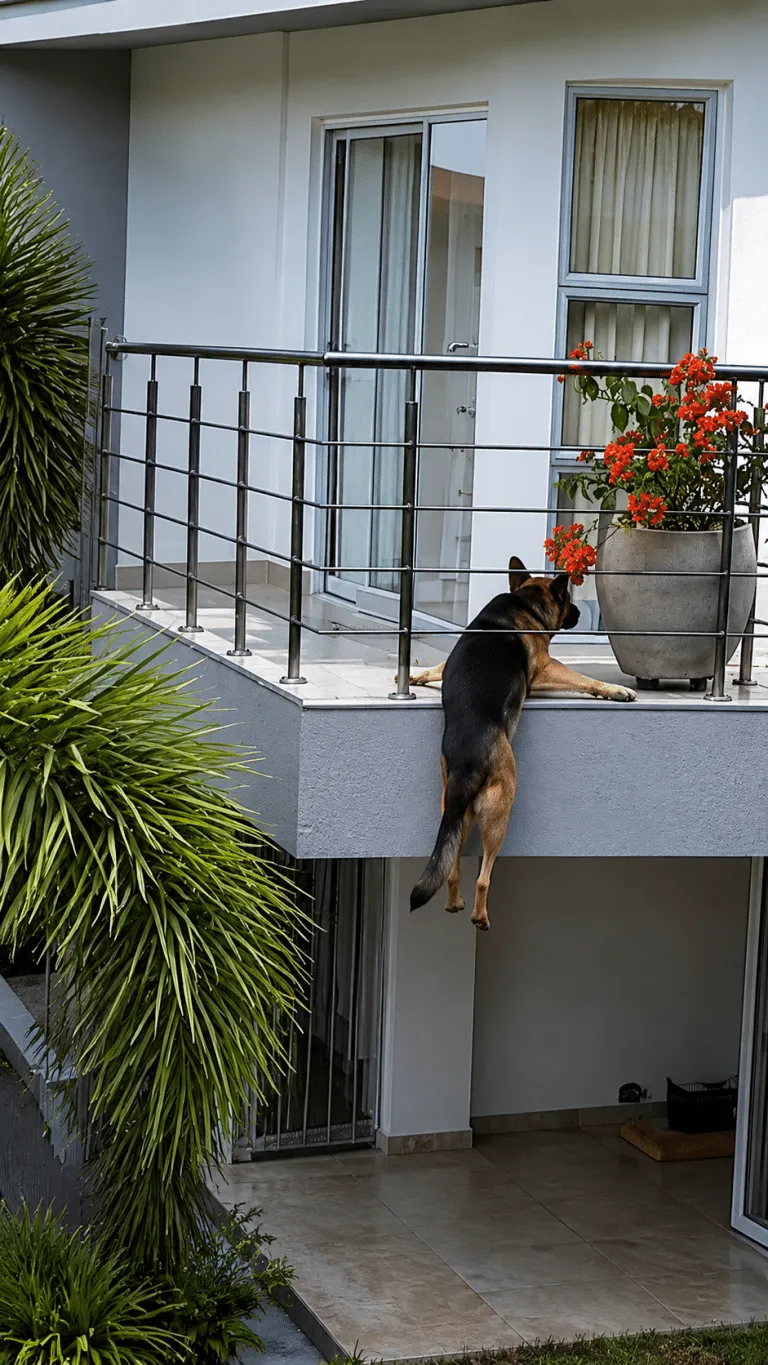
A German Shepherd was enjoying a quiet afternoon on an apartment balcony when something went terribly wrong. Somehow, the large dog slipped beyond the railing, leaving his body suspended high above the ground with only his front paws holding on to the edge.
His hind legs struggled to find support, but there was nothing beneath them. Every movement threatened to loosen his already fragile grip. Unable to climb back onto the balcony, he began barking urgently, his calls carrying through the open air.
Inside the apartment, a woman heard the unusual barking and hurried toward the balcony. What she discovered was far more serious than she could have expected. Her dog was hanging outside the railing, and the distance between them suddenly seemed frighteningly difficult to cross.
VIDEO: German Shepherd Hangs From a High Balcony as His Owner Rushes to Save Him
The Balcony Had Become a Place He Could No Longer Escape
For many dogs, a balcony is simply another familiar part of home. It offers fresh air, unfamiliar sounds from the street, and a place to watch the world beyond the windows.
But familiar surroundings do not always mean safe surroundings.
In this case, the German Shepherd had somehow ended up on the wrong side of the barrier. The exact movement that caused him to lose his footing was not established, but the danger of his position was unmistakable.
His front paws were his only remaining connection to the balcony.
A German Shepherd is a substantial animal, and supporting that weight with only the front legs would be difficult even for a strong, healthy dog. With his hindquarters hanging freely, he had little opportunity to regain his balance.
The more he struggled, the harder it became to maintain his position.
His barking was particularly important because the woman inside could not immediately see what had happened. Without those sounds, she might not have realized how urgently he needed assistance.
Dogs bark for many reasons, from excitement to warning. Yet this time, the sound brought his owner toward a danger that would otherwise have remained outside her view.
And when she reached the balcony, there was no time for a complicated plan.
Reaching Him Was Only the First Difficulty
The woman hurried toward the railing and leaned forward to reach her struggling dog.
It was a difficult position for both of them. The German Shepherd was already outside the balcony, while the woman needed to pull him toward a secure surface without allowing his body to slip farther away.
She could not simply ask him to climb back.
His paws had already been struggling to keep him suspended, and the difference between holding his position and lifting his entire body was considerable.
The woman grasped him firmly and began helping him back toward the balcony.
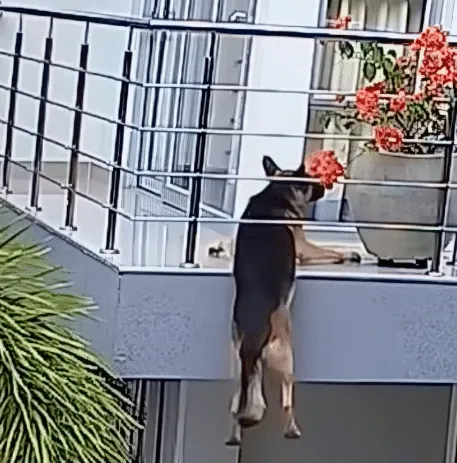
The physical challenge was significant. A large dog’s weight becomes especially difficult to manage when much of its body hangs below the level of the person trying to lift it.
She needed to maintain her hold while bringing him closer to the railing. At the same time, she had to avoid movements that might further destabilize him.
The rescue depended on something deceptively simple: keeping contact long enough to bring his body back onto a surface that could support him.
From the outside, the moment might appear to be a straightforward effort to lift a dog.
But there was nothing straightforward about reaching across a high balcony and trying to recover an animal that could no longer support its own weight.
Each movement mattered.
The Moment His Weight Returned to Solid Ground
The woman continued pulling until the German Shepherd could be brought back onto the balcony.
The change was immediate and profound.
Moments earlier, his front paws had been the only things preventing a fall. Once his body was safely inside the railing again, he no longer had to struggle against the empty space beneath him.
The frightening uncertainty of the situation had ended.
His owner had reached him in time.
What makes this rescue particularly striking is how ordinary the circumstances were before the emergency. There was no distant wilderness, flooded river, or abandoned building. The danger developed in a place the dog already knew, only steps away from the room where his owner had been staying.
That closeness made the rescue possible, but it did not make the situation less serious.
The woman’s response also revealed how much can depend on recognizing an unusual change in an animal’s behavior.
She heard the barking, went to investigate, and discovered that her dog needed immediate physical assistance. The sequence was brief, yet every part of it mattered.
The account does not establish whether the dog subsequently received a veterinary examination or whether any minor injuries were discovered. What it does show is that he was brought back from a dangerous position before he fell.
That outcome was the most important change of all.

A Familiar Home, Seen Differently After the Rescue
After an emergency like this, a balcony can no longer be regarded as harmless simply because a dog has used it safely before.
Large dogs may appear especially secure on their feet, but strength cannot compensate for every awkward position or unexpected loss of balance.
The German Shepherd’s experience illustrates how quickly an animal can become helpless when its surroundings offer no reliable foothold.
It also brings attention to the quieter relationship between a dog and the person who cares for him.
The woman did not need to understand every detail of what had happened before responding. She heard something unusual, recognized that it needed attention, and went to find out why.
That decision brought her to the balcony at the moment her dog needed her.
There is no confirmed account of how he behaved later that evening, whether he returned to the balcony, or whether his owner changed the space afterward. Those details remain unknown.
But the central image of the rescue needs little embellishment: a large German Shepherd hanging beyond a railing, a woman reaching toward him, and the gradual movement that brought him back to safety.
The distance separating danger from security was only the width of a balcony railing.
For this dog, crossing that distance again was something he could not accomplish alone.
In the end, the most meaningful part of the story was not the height of the building or the dramatic sight of a dog suspended above the ground. It was the connection between a sound from outside and a person who recognized that something was wrong.
“Sometimes, the difference between an ordinary afternoon and a life-changing moment is simply whether someone hears a cry for help and comes close enough to answer it.”







fwse
dsf